



How to Choose a Hole Saw
It's always important to understand how to choose a hole saw and which models to purchase for specific work. Because this tool - composed of a toothed bush - remains fundamental in the equipment of any DIY and home improvement enthusiast.
But it is also a protagonist in the toolbox of a worker, an artisan, a professional carpenter or mason. A circular mill for making wide and precise holes cannot be missing. Indeed, we could say that you need a proper set of hole saws.
In order to cover all diameters. But what are the fundamental characteristics to observe when you are about to purchase your mill kit? Here's a manual to have as a reference when you need to replenish your series of drill bits suitable for every circumstance.
Use of the hole saw
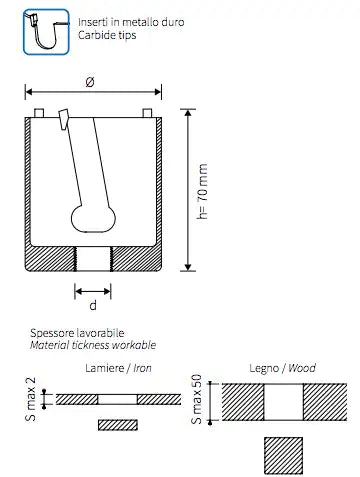
The first parameter you must always evaluate when choosing your hole saw: what is it for? There are models dedicated to wood, others for drilling metal sheets and solutions for building materials of any kind.
You can also drill concrete with a hole saw but you must use the right model, the tooth pitch changes based on circumstances. So, do you have a project you need to move forward with?
Choose a suitable hole saw and this also concerns diameter: there are solutions you can use to make holes slightly larger than a normal drill bit and others - wider and more generous - to pass pipes through.
For example those from air conditioning units.
It's hard to find a universal hole saw but there are models suitable for most uses. Like, for example, the Krino bimetallic hole saw HSS
An essential model for everyone that you can use for wood and metal, steel sheets, iron and light alloys, hard plastic.
Structure of the mill
An essential aspect for choosing the best hole saw: how should it be structured? In some cases you choose the TCT models with guide tip and spring to automatically eject the metal disc or wood. These are very convenient solutions.
But it's important to evaluate how they are made. For example, the high-performance BIMASTER hole saw has HSS M3/1 teeth with reinforced profile, an excellent solution to deal with the impacts and vibrations typical of cordless drills and drills.
Krino TCT models have hard metal inserts in the teeth to make the action even more incisive while those who work every day with stainless steel or high alloy and very resistant ferrous materials can try the ground HSS-G (therefore born from a single block) and coated with TIALN. That is titanium aluminum nitride to increase thermal resistance and resistance to stress.
Material of the product
Before buying a hole saw you must absolutely evaluate how it was forged, what material was used to define its structure. The starting point is, of course, HSS steel. That is high speed steel, an ideal combination to give cutting tools the resistance and toughness needed to face the challenges of the hardest and most difficult materials to drill.
For demanding work Krino proposes the bimetallic hole saw HSS-CO 8% that is with a high percentage of cobalt in the composition of the tip: this allows you to increase resistance and effectiveness on stainless steel, iron, brass, cast iron, wood and plywood. And construction work? How are wide drilling completed without damaging the bits? We can use a hole saw.
But with teeth coated with tungsten carbide, a material perfect for scoring bricks, concrete, natural stone and walls. Then there's the Keramaster Plus diamond mill with M14 connection for drilling porcelain stoneware, tiles and extremely hard building materials.

In any case, to have a clear picture of the options, here above you have the entire Krino hole saw range divided into a matrix that helps you understand which to use in certain situations. Want more information? Contact us right away.


