



What Are Metal Milling Cutters and What Are They Used For?
You must have surely had to drill a hole in wood. And that's when the choice of the best bit comes in, which for this type of material has a special shape, different compared to solutions for drilling iron or stone. But you can also consider using mills for metal. There are many of them, they have different structures and serve to consume the contour.
These are particular bits, you recognize them immediately thanks to their special shape, with rounded profiles that inspire a different machining compared to standard drilling. If you want to work well with this base you can't ignore the potential of mills for the drill: here's what they're for and how you can choose them to have a well-stocked toolbox.
The mill for metal, definition: what is it and what is it for?
The mill is that tool used to model the shape. It is a rotating bit, mounted on a drill, necessary to remove excess material compared to needs and create specific shapes. The mill defines the metal thanks to cutting edges and through constant movements, allowing the definition of edges, grooves, angles, holes and notches.
This type of bit - very much used in carpentry and joinery but also in DIY - is available in various shapes and sizes, can be mounted on manual drills and column drills or machines dedicated to this work known as mills. It has a functional and ornamental role: the mill for metal is used to work on details and precise finishes, and is useful in valuable artifacts.
What work can I do with a metal mill?
The list of possible operations that bear the signature of a mill designed for steels and iron is infinite. As anticipated, the first point to highlight is that there are decorative operations - purely aesthetic - and functional to the structure of the artifact.
Specifically, the operations you can accomplish with a wood mill are different: ranging from grooving and joining for assembly of parts to the ability to trim edges to obtain a smooth and uniform surface.
You can use mill tips to engrave iron, decorate it, add a step or an edge. But you can also use certain solutions to clean a hole or shape, chisel and grind. In short, everything depends on which tool you've purchased.
How should a mill for working metal be?
To have a clear idea of how to proceed and which mill to buy it is enough to take a look at the Krino catalog. Here you find a series of precise indications that suggest you the essential characteristics of a bit for precision work.
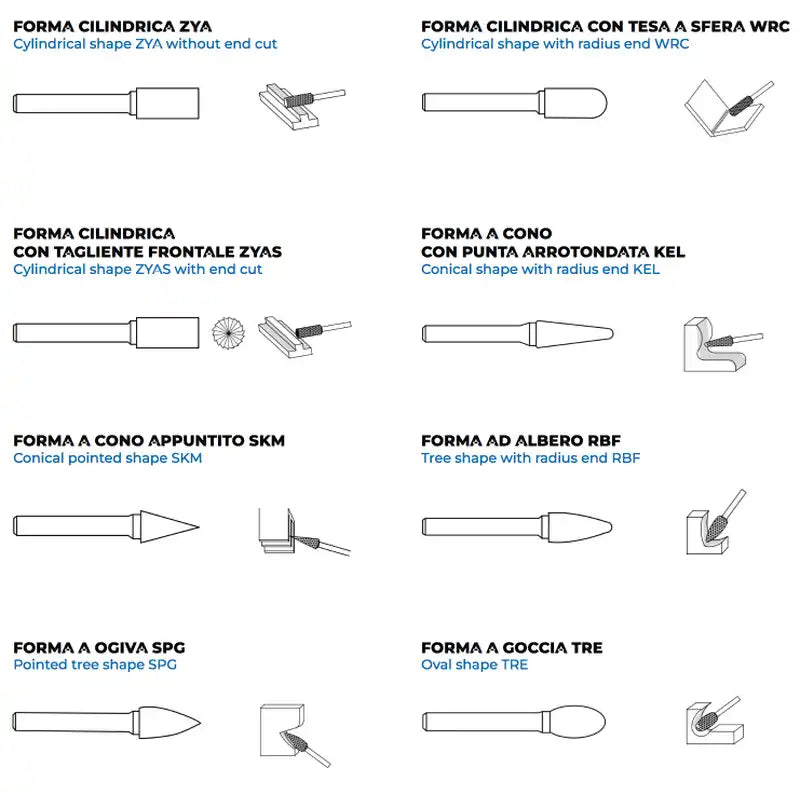
First of all you must evaluate the cut: the structure of the blade can guarantee good results in determined conditions. For example, the standard cut is perfect for filing weld beads, cast iron and base steel while the one specific for aluminum is used to operate on this type of metal but also for work on plastic and hard rubber. The cross cut, instead, is perfect for hardened steels.
Then we must evaluate the shape: which to prefer? It depends on the purpose: you can choose the cylindrical one with or without sharp front, conical, spherical or pointed. The bits can be rounded or not, based on work requirements.
What material to use to build drill mills?
On this point we cannot waver: it takes a solid structure guaranteed only by the best material to face the challenges of milling. So, what to choose? To make these tools we use hard metal, namely Widia which is also known as tungsten carbide. Why use this combination? First of all for mechanical resistance: tungsten carbide - thanks to fusion with carbon - is extremely hard and offers wear resistance superior to many other cutting materials.
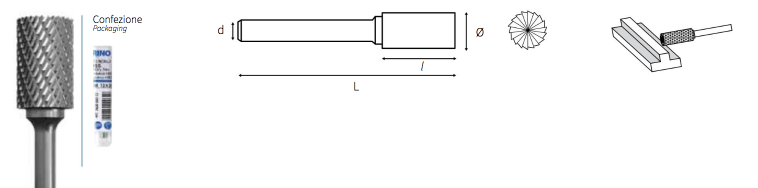
Moreover Widia also offers great heat resistance, which is perfect for high-speed work like milling. High toughness, rigidity and compression resistance complete the picture: work on hard materials must exploit this solution. And for Krino mills the K20 version is chosen with great abrasion resistance, in some cases coated with TiAIN.
That is titanium aluminum nitride which imparts hardness, thermal and chemical resistance, increased performance and reduced friction. A mill for metal with these characteristics can give you important results for more demanding work.


