



Types of Circular Saw Blades to Choose From
Choosing the blade for the circular saw means deciding how to organize your work. A quality solution can help you complete operations successfully, respecting measurements and structure of the product. While a poor quality blade leads to what you can easily imagine: chipped profiles, damaged objects, raw material to throw away because it was cut wrong.
That's not what you want, even if these operations are amateur and for home DIY work. Not to mention if the circular saw blade is for professional work. The watchword is always the same: quality. Here's how to choose the blade for the circular saw.
Material of circular saws: Is HSS enough?
Most circular saws with quality blades take HSS as a reference, that is high speed steel. A material that has always characterized cutting tools like drills and mills that work at high speed with precision.
The best blades have a percentage of cobalt and are recognized by the HSS-Co acronym while HSS-G blades are equally effective but have their strength in precision and robustness when working steel, cast iron, brass and bronze since these products are born from grinding a single block. This allows you to rely on tools of extreme quality and toughness.
Types of circular saw blades for specific materials
The first parameter to consider: circular saw blades change based on what you need to cut. The main solutions are fairly obvious, you move from iron to wood up to options for building materials. A bit like it happens for drill bits, circular saw blades also have different characteristics in relation to what they need to cut.
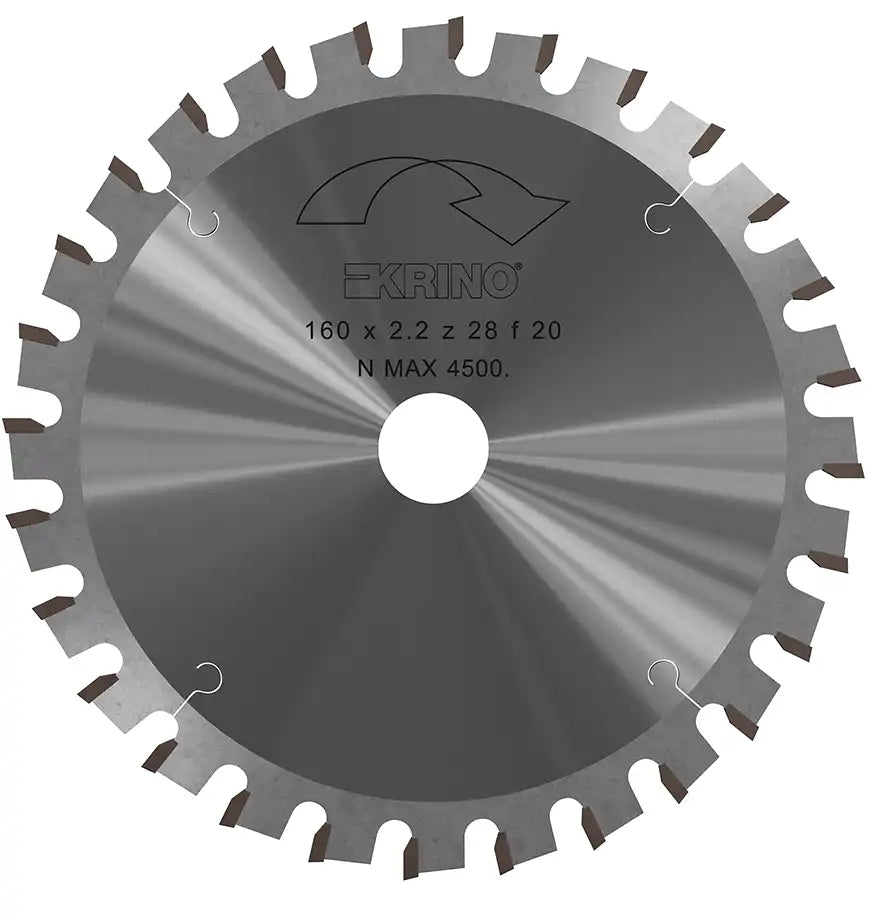
There are also universal products like those you find in the Krino catalog that help you work with good results. But when, for example, you need a cut on steels and ferrous materials you must aim for specific solutions. For example, model 27050 is designed to work well with aluminum and plastic: if you use this saw for specific materials you get perfect results.
Structure of the circular saw and number of teeth
Here's a crucial point to choose the circular saw suitable for the work. Let's start from the base point: the diameter. This parameter influences the cutting depth and must be chosen for the characteristic of the machine on which you are mounting the blade.
Then there is a fundamental aspect that defines the quality of the final result: the distance between the teeth. There are options for rough, finish and universal. What changes between these different types of circular saw blades? The pitch between the various cutting elements.
The smaller this parameter, the greater the ability to cut on blocks that are particularly voluminous and thick. But at the same time a blade with many teeth, thus a reduced pitch between the various elements, the greater the precision and cleanliness of the cut.
This type of blade is used for plastic, metal, wood with minimal thickness. Wide and hard materials are worked with reduced tooth pitch. Remember that with rough saw blades you cut solid wood along the grain, with finish blades you can operate transversely.


