



Self-Locking Washers: What You Should Know
During the maintenance of industrial machines, the construction of metal and wood works, the use of tools suitable for processing, it can happen that you encounter anti-loosening washers. If you can't remove them, don't insist and don't force: you can cause damage.
In fact, there are precise techniques. These metal plates drilled with a specific intent: allow bolts and screws to remain well in place. And avoid loosening without your precise command through suitable tools. Like, for example, operating levers, screwdrivers and inserts. Do you want more information on this topic? Continue reading to deepen.
What are anti-loosening washers
With this term we mean a series of thicknesses with circular shape and a central hole that are placed between the base surface and the fastening element. Like nut, bolt, screw. This happens with the aim of avoiding unexpected loosening.
In certain circumstances, especially in intensive use and in safety applications such as, for example, the wheel of a car or a mechanical arm of an excavator, an unforeseen loss of fastening can cause important problems. That's why in many occasions it's important to correctly use the best anti-loosening washers with anti-lock device suitable for the specific use.
How do you recognize these metal elements?
The rollers designed to prevent a loss of fastening are recognizable by the shape and some technical characteristics relating to the realization. First of all, we always talk about a structure in stainless steel, resistant to weathering and atmospheric agents. Other locking and safety elements are mechanically galvanized or made of raw, greased steel.
Then, the shape is almost always circular but in some cases we find ourselves in front of a structure with teeth as if the washer were composed of a succession of lamellae. You can recognize anti-loosening washers by an interruption of its continuity, as if it were broken. Or there is an extension on one side that must be bent by hand.
How many types of anti-loosening washers are there?
You can find different locking systems with washer shape. The use of these elements is very practical and convenient because they allow you to operate in complete autonomy: put the bolt in, insert the washer, tighten the nut and the work is finished.
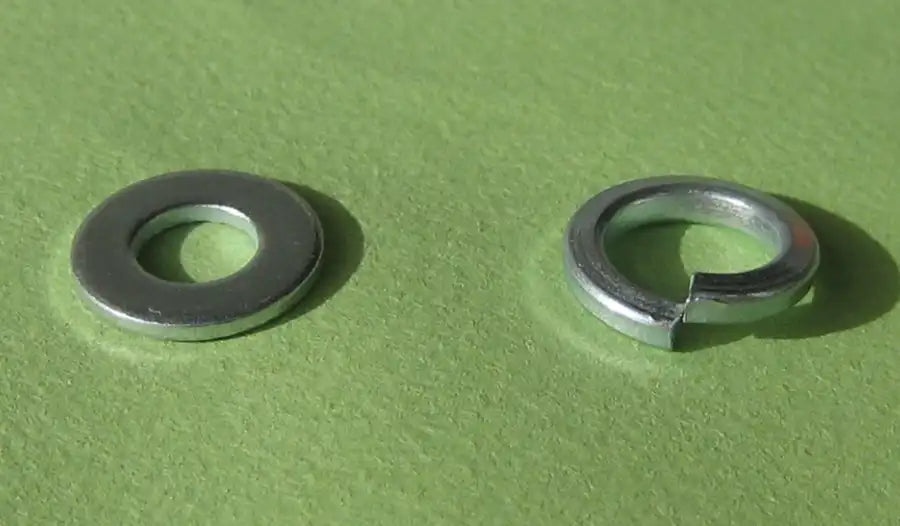
Meanwhile there are those who ensure the proper fastening to the structure, it's enough to choose the type of anti-loosening washer. What is the ideal solution? First of all, there is the model with one or two safety tabs: once the nut is tightened, you bend these elements so that it remains firm. This way it becomes easier to prevent the unintended loosening of bolts and screws.
These models, including washers with internal or external nose, are suitable for intense applications with considerable vibrations. Then there is the large family of elastic washers in which we also find the Grover models (photo below, Wikipedia), the Belleville washer or wavy washers: once the bolt is tightened, they maintain high tension and guarantee the solidity of the mechanical connection.
The toothed, grooved or jagged washers for wood are finally those that present a toothed profile on one or both sides. The torsional force allows these cutting elements to penetrate the surface and create friction to ensure safety. A special model is the paired anti-loosening washer which is composed of two toothed elements that interlock and create a wedge under the nut. Thus it blocks bolted connections subject to strong vibrations and stresses with dynamic loads.
Anti-loosening washer: how does it work?
The operation of a toothed, elastic or broken washer: simply tighten the bolt or screw to activate the properties that can be created which can be the creation of a tension (as happens for spring-type models like the Grovers), a locking or friction element.
How do you avoid the fastening of screws? To use these tools, you must first choose the right solution for your needs. Then insert the washer anti-vibration or lock before tightening the nut or bolt. Choose a suitable insert - like those from Krino that you find in the general catalog - and use a good screwdriver to tighten everything. Models with tab provide for a subsequent phase: bend the metal element to ensure maximum strength.


