



Cutting a Wall (Without Creating Dust)
One of the activities for those who work in construction: cutting a wall. In many cases it is about shaping and creating a line to guide demolition activities with as much precision as possible. For thinner walls, perhaps made with less demanding materials and therefore not concrete, we talk about different cuts. You know it's also difficult to drill a hole in reinforced concrete wall, imagine cutting it.
We need suitable tools and techniques to complete the work with maximum possible precision, without structural damage to the walls. And maybe avoiding the dust cloud that often rises when you decide to segment a plastered wall.
Why do you need to cut a wall, what is it for
The reasons that drive you to sawing a wall can be different. It might be necessary to shape an internal wall during a renovation project to modify the order of spaces and create a different environment, perhaps more spacious.
It could be essential to cut a wall to join two adjacent spaces or proceed to repair a damaged structure that needs to be fixed. Often, part of the wall is cut to make room for a door or window. Another reason that can lead you to use a blade to create a profile: create traces for water or electrical systems in home walls.
Read: what are the best drill bits for hard metal?
The precautions to take before starting
All these reasons, however, must always be defined by a renovation professional. Like, for example, an architect. Cutting a wall can cause major structural damage. And serious risks to your safety and those living with you.
Before cutting a wall you must make sure there are no pipes or cables running where you want to perform the work: such a situation can lead to serious structural damage but also to risks for your safety. In any case, for this work you must wear all required PPE equipment: gloves, protective glasses against splinters, dust mask and safety shoes.
The tools to easily cut a wall
What can you use to cut a wall? Overlooking construction machinery and industrial tools that allow major openings in reinforced concrete walls, the main tools for cutting medium-sized walls are angle grinders. That is, circular saws that are used with both hands and that allow vertical and horizontal cuts.
Professional tools are often rented because they are rarely used to amortize costs. For less demanding applications, on small walls and simple cuts, semi-professional equipment can be used.
Even a small or large angle grinder can be used to cut surfaces in construction. In addition to the motor power that determines the possibility of incising on a surface, the diameter of the blade comes into play which influences the cutting depth.
How to incise the wall (and avoid dust)
A fundamental detail: when you start cutting you must always have the line to follow well in mind. Draw with chalk or a pencil (the classic mason's pencil) the path of the blade: turn on the tool after putting on the PPE and gently sink into the wall. Proceed slowly but steadily all along the line. Now you have another problem to deal with: The dust.
Which makes it impossible to manage the work. In these cases you must wet the blade (if available to this treatment) and the surface, always being careful not to let water reach the power tool. For this reason, the use of equipment with specific accessories such as vacuum cleaners connected to a construction vacuum bucket is recommended. This way you can cut a wall without making dust.
How to choose the blade to cut a wall
The diamond blade for cutting building materials is the best solution for incising walls, even those in concrete. Other solutions will be damaged by the hardness of the material and you will manage to damage the wall without getting the desired result. Choose saws for concrete with diamond cutting, there are solutions dry and for water cooling.
The first case is perfect for deep cuts but when they are not explicitly necessary it is better to use the second ones because they allow you to work without dust and with more safety for the blade which does not overheat. In fact dry blades must be handled differently by letting the disc spin empty for several seconds to avoid overheating.
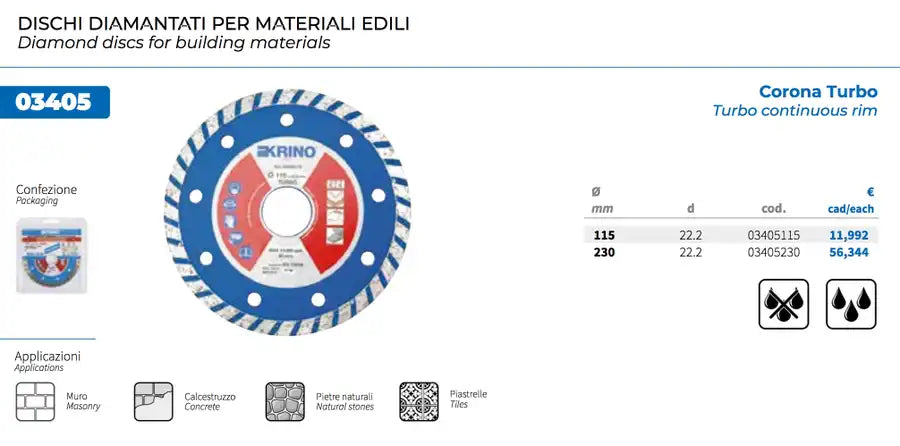
One of the most interesting solutions comes from the Krino diamond disc collection, perfect for construction work that operates in this direction. With the diamond crown of these circular saws you can safely incise concrete walls, bricks and natural stone.


