



Milling Wood: How to Proceed and Which Tools to Use
One of the most interesting activities for artisan processing and carpentry: wood milling. With the right power tools, and above all with the right high-quality bits, we can go beyond the activities of cutting and drilling wood. Certainly, no one wants to question these pillars of DIY: in most cases we need to drill, cut, file and plane.
At most we venture into the use of sandpaper to remove paint from wood. But it doesn't work that way, if you want to achieve good results and take a step forward in the world of artisan wood processing you need to learn to mill. Do you know what I'm talking about? Here's a small guide that will help you gain familiarity with the techniques and tools for milling wood.
What does it mean to mill wood, definition
A detail to be explored before launching into lists of solutions: do we give a clear definition of this process? Certainly, milling wood is that activity that allows you to consume a block of material, with specific cutting tools, in order to remove a section. The purpose can be both decorative and functional and allows you to obtain grooves, depressions, traces.
Without going into detail (we'll do that later), wood milling happens through a basic mechanism: there is a milling machine on which a bit or blade with different shapes is mounted based on purpose. This is the mill that consumes the wood. Once the rotary movement of the section is activated, the milling machine is directed along predefined paths to achieve a precise result.
Why do you need this operation?
Wood milling serves to create work on surfaces that need decorations or specific structures for joints and guides. For example, if you want to make a window you may need space for the lock or the glass. In these cases the mill can help you. Or, if you're working on a homemade frame you can use a mill to shape the profile and get the decoration you prefer. Well, that's the ultimate purpose of the milling machine. Which one to choose?
Tools and techniques for milling wood
Milling wood is an activity with various specializations. For industrial work we can use a toupie with work bench and protruding bit to achieve the desired result. In common use we can operate with vertical and horizontal mills driven by hand or column drills to make holes with particular structures. What speeds to follow?
Much depends on the hardness of the wood: with hard wood to mill a rather low number of revolutions is recommended so as not to burn the wood and damage the mill. Now let's talk about the power of column drills: which to choose to make good milling work? If you want interesting results you must provide for the evaluation of power: from 750 to 900 W you have an excellent tool.
The bits (or mills) for working wood
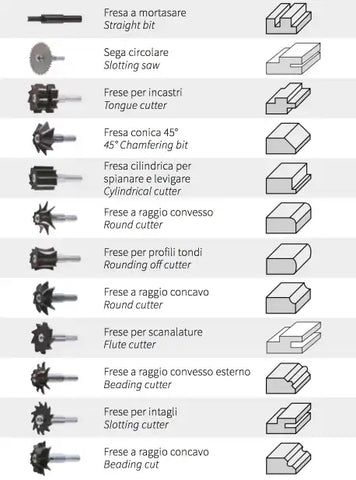
A large portion of the work - in fact, most of it - is performed by the bit. Which should always be in superior steel to be able to achieve the right results, over time, without chipping of the profile and inaccuracies in the output. That is, of the milling performed.
If you choose a quality mill and use it the right way, evaluating execution speed and type of wood, the result will surprise you. But, as anticipated, the choice of the mill is decisive. For example, take a look at the Krino catalog.
The mills that you can purchase allow you to choose a series of solutions for profiling hard and soft wood. So you have the right condition to make round, concave and convex profiles, grooves, joints and mortises.
Always in the same category, we also have cylindrical, spherical, conical rasps and Forstner mills of various sizes.
These tools are used for dowels and hinges that are fundamental for those who want to do DIY and wish to make furniture at home.
Or perhaps to make a small modification. You don't have to be a seasoned professional carpenter to appreciate the quality of Krino mills for wood of any kind. If you want to delve deeper into the topic you can take a look at this in-depth video: review of the Forstner mill art. 05063.


